Breaking The Love Curse
Breaking the Love Curse
Within Embodied Unconditional Love for Self
The flower on the wrong eyes
In A Midsummer Night's Dream, the fairy king Oberon sends Puck to fetch a little flower called love-in-idleness. Cupid's arrow once struck it by mistake, and now its juice, squeezed onto sleeping eyes, makes a person fall for the first living thing they see when they wake.
Puck gets the wrong man. Lysander, happily in love with Hermia, wakes, sees Helena, and drops Hermia on the spot. Puck tries to fix it by enchanting Demetrius too, and now both men are chasing a woman who can't believe she's being loved. Meanwhile the fairy queen Titania wakes and adores Bottom, a weaver wearing a donkey's head.
The spell rarely invents anything, though. It exposes what was already there. Long before any flower, Helena was begging for scraps from a man who scorned her, calling herself his spaniel: the more he beat her away, the more she fawned. The magic just makes everyone else's love as irrational as hers already was.
And not everyone is released. Lysander gets the antidote. Demetrius never does, and marries Helena still under the spell. Shakespeare leaves it open whether that's true love restored or an enchantment that never ends.
The misunderstanding at the root
Under every love curse sits the same misunderstanding: that love lives outside us and has to be won from someone else.
It usually starts early. A child who doesn't get unconditional love, often from a father, learns to go looking for it. She learns that love is earned by being good, being pleasing, not being too much. Over time that hunger can turn inside out and show up as desire: the need to be wanted, chosen, pleasured.
But being desired isn't the same as being seen, and it's not the same as being loved. So the pattern repeats. We abandon ourselves for fear of being abandoned. We make ourselves smaller so no one leaves. We give, and underneath the giving sits a quiet deal: if I heal you, you'll stay. If I open your heart, you'll love me back.
The man who gives only breadcrumbs is the perfect partner for this wound. Intense one moment, silent the next. Intermittent, unpredictable reward is the most addictive pattern there is, more gripping than steady love, so the nervous system bonds to the waiting itself. Every time we cut it off, it feels like cutting off part of ourselves. What we're really cutting is the hope we placed in him.
Mirrors, twin flames and the arrow
Some connections feel deep the moment they begin. It feels like a twin flame, a soul connection, someone we've known forever. The recognition is real. But often what we're recognising is ourselves.
People are mirrors. The one who hooks us hardest usually reflects both our deepest longing and our oldest wound at the same time. That's why it feels so intense so fast: we're not just meeting them, we're meeting the parts of ourselves we've been waiting to find. Jung called this projection. We fall for an image in our own psyche and place it on whoever is in front of us when we open our eyes.
So the rapture is also a rupture. The connection breaks us open, and the breaking sends us looking for what we thought they held. It feels like losing them. It's really the start of finding ourselves.
The myths have always known this. Ovid tells how Cupid shot Apollo with a golden arrow that causes love, and the nymph Daphne with a lead one that causes aversion. One burns while the other flees, and Daphne only escapes by turning into a laurel tree. Love and refusal arrive together, and neither is chosen.
Echo and Narcissus show the mirror at its most painful. Echo is cursed to repeat only the last words of others, so she can never speak her own. She loves Narcissus, who can only love his own reflection. Her love goes out and nothing comes back, until she fades to a voice. It's the purest picture of loving someone who can't see anything but themselves, while losing our own voice in the process.
Each of these stories is about the same thing: bleeding our power outside ourselves. Into the arrow, the potion, the beloved, the reflection. The way home is always to call that power back.
Sophia: looking for the Great Father
In the Gnostic texts, Sophia is divine Wisdom, the youngest of the great powers. She longs to know the Father, the unknowable source, and she reaches for him alone, without her divine counterpart.
The longing itself is holy. What goes wrong is the reaching outward, alone, toward a love that can't be grasped. In the Pistis Sophia, she sees a light shining down in the chaos below. She mistakes it for the true light, goes down toward it, and is trapped.
It was only ever a reflection. That's exactly how the breadcrumb works. It glints just enough to keep us moving toward it, so it looks like the light. But it's an echo of what we long for, not the source. And so often the whole fall begins where Sophia's did: with longing for a father who couldn't be reached.
Sophia doesn't climb out by grasping harder. She grieves. She sings out her sorrow and repentance again and again. Then the Christos comes down to raise her. He isn't a stranger who rescues her. He's her own counterpart, the half she went looking for in the wrong place. She's restored to her pair.
That's the turn in every one of these stories. What we chased outside was always meant to be found within, and union comes when we stop reaching and let ourselves be met.
Psyche: love in the dark
Psyche is so beautiful that people stop worshipping Venus and worship her instead. Venus is consumed by jealousy and sends her son Eros to make Psyche fall in love with a monster. Instead he pricks himself with his own arrow and falls for her.
He takes her to a hidden palace, but only comes to her at night, and she's forbidden to see his face. That's breadcrumb love: intense in the dark, gone by daylight, never fully shown. Her jealous sisters visit and stir up her doubt, and one night she lights a lamp to see who she's really with. A drop of hot oil falls on him. He wakes and flees.
To win him back, she has to face Venus, and Venus sets her tasks. Each is a lesson in coming back to ourselves:
Sorting a mountain of mixed seeds: discernment. Telling desire from love, intensity from intimacy.
Gathering golden fleece from violent rams: taking back power without being trampled. She waits until dusk and picks it off the brambles rather than charging in.
Filling a flask from the river Styx: taking a contained portion of something overwhelming, seeing it from above with the eagle's help instead of drowning in it.
Descending to the underworld for a box of Persephone's beauty.
On that last journey she's given two coins and two barley cakes, and told that people will call to her for help on the way: a lame man, a drowning man, women weaving. She must walk past every one of them. They aren't villains, and their need is real. But if she stops, she'll give away what she needs to get home.
This is the healer's trap. Giving isn't the problem. Giving with a hidden hook is: I'll heal you so you'll love me. The one on the path calling to be loved, nurtured and healed often sounds exactly like our own inner child, which is why we keep stopping. Their healing is their own descent. We can wish them well and still walk on.
The martyr and the saviour
Underneath the hook there are often two familiar faces. The martyr gives until she's empty, then quietly resents that no one gives back. The saviour needs someone to need her, because being needed feels like the closest thing to being loved. Both look like kindness. Both keep our attention fixed on someone else's wound so we never have to sit with our own.
It's worth remembering that Psyche's name means soul. Her whole story is the soul's journey to save itself. She isn't sent into the underworld to rescue anyone. She's sent to come back whole. Every time she might stop to save someone along the way, the instruction is the same: keep walking, or you'll lose your way home.
Even in the Sophia myth, the saving isn't done by her. She has to grieve and call out first, and then her own counterpart comes for her. We can't be someone else's Christos. Trying to be is one more way of bleeding our power outside ourselves.
We're here to save our own soul first. That isn't selfish. A soul that has come home to itself can give freely, without needing to be paid in love, and that's the only kind of giving that really heals anyone.
When Psyche and Eros are finally reunited, she's made immortal, and their daughter is named Voluptas, Pleasure. Pleasure was never the problem. It's the fruit of the union once she's whole, not the bait that keeps her in the dark.
The jealous sisters
Jealousy runs right through this story. Venus envies Psyche. Psyche's sisters envy her palace and her lover. It's the feminine turned against itself, competing for love as if there isn't enough to go round.
That's what the belief that love lives outside us creates: scarcity. If love has to be won, then other women become rivals and our own beauty becomes a threat. The sister turns into the enemy, and so does the part of ourselves we've judged as not enough.
Inanna and her sister below
The oldest version of this story is Sumerian. Inanna, Queen of Heaven, the goddess of the planet Venus, goes down to the underworld to visit her sister Ereshkigal, Queen of the Great Below.
The two sisters are opposites. Inanna is the bright one, loved, adorned, desired. Ereshkigal is the one left in the dark, alone, grieving. When Inanna arrives, Ereshkigal's rage meets her at the door.
At each of seven gates, Inanna is stripped of something: her crown, her jewels, her robe, every sign of her power and allure. She arrives naked, is judged, and is killed. Her body hangs on a hook for three days.
This is what a love curse does. It strips away everything we thought made us lovable, especially being wanted, until there's nothing left to bargain with.
Met in her pain
What gets Inanna out is the most important part of the story. Her loyal servant, Ninshubur, goes from god to god asking for help. Enki makes two tiny beings from the dirt under his fingernails and sends them below.
They find Ereshkigal groaning, in pain like a woman in labour. They don't fight her, fix her or argue with her. They simply feel it with her: oh, your belly, oh, your heart. Because she's finally met in her pain, Ereshkigal softens, offers them a gift, and they ask for Inanna's body. Inanna is restored.
Ereshkigal is the abandoned, raging, grieving part of us: the little girl who didn't get unconditional love, and the dark sister we've judged and pushed below. She doesn't need beating into submission. She needs someone to sit with her groaning until she's ready to let go. That is what inner child work and nervous system work really are.
The one who didn't mourn
When Inanna comes back up, she finds her consort Dumuzi sitting on her throne, dressed in fine robes, not mourning her at all. For the first time she sees him clearly, and she sends him to the underworld in her place.
There's no drama in it, just clear sight. Someone who didn't grieve your absence doesn't get the seat beside you.
The dark feminine who wanted love too
The shadow side of all this is the alluring, manipulative feminine: the one who hooks, seduces and controls through desire. She's the wicked queen asking the mirror who's fairest, Venus jealous of a mortal girl.
It's easy to make her the villain. But she wanted love too. She's what a girl becomes when she learns love has to be earned: be desirable, be captivating, and maybe this time they'll stay.
She shows how pleasure and power feed each other. When pleasure is fused with power, it becomes a lever to hook, hold and control, and it grows the ego. When pleasure is held by truth, it goes back to being life force. Same energy, different master.
So she's cleared the way Ereshkigal was met: with understanding, not disgust. She doesn't get to run anything anymore. But when the need underneath her is heard, she stops coming back in new disguises.
The coin for the crossing
In ancient Greece, a coin was placed in the mouth of the dead to pay Charon, the ferryman, to carry them across the river into the underworld. Without it, a soul was left wandering the bank.
Psyche carries two coins in her mouth, one for the way down and one for the way back. The ferryman has to take each one from her himself. That's why she can't stop to help the people calling out along the way. Every coin she gives away is her passage home.
So in a descent, a coin isn't a symbol of death. It means the initiate is expected to return. It's our worth, our path, our freedom as a soul. When we offer ourselves to heal someone else so they'll love us, we spend it on their crossing and lose our own.
Is it unconditional?
The unconscious shows its true intention in what happens after we give. If the love was unconditional, we give and it's done. We feel lighter. There's no waiting.
If there was a hook, it surfaces as checking the phone, resentment when nothing comes back, keeping score, the body tightening at silence, or the story starting up: after everything I did for them. A simple test helps: if I give this and get nothing back, will I still be glad I gave it?
Most human love is mixed, and that's fine. We don't need perfect purity to give. We just need to see the hook clearly enough that it stops running us. And unconditional love doesn't mean unconditional access. Loving someone without needing anything back is exactly what makes it possible to let them go.
The fire and the appeasing voices
When we try to close the door, two voices often argue. One is a fire that wants to cut off completely. The other tries to appease, to keep the line open just a little.
The fire is the inner masculine: the sword that has seen enough. The appeasing voices are the little girl's fawn response, a survival strategy from a time when love was unreliable: keep the connection at any cost, don't be too much, don't be the one who leaves. If the sword acts while she's still terrified, she'll reopen the door the moment the fire dies down.
So we turn to her and ask what she's afraid will happen. Usually it's: then no one will want me, then I'll be alone, then I'm the bad one. That's the unworthiness belief in her own words, and it can be answered: you don't have to keep anyone to be safe. I'm staying.
The Buddha taught steadiness through the eight worldly winds: praise and blame, gain and loss, pleasure and pain, fame and disrepute. That equanimity can't be forced. If we try to stop caring before the child feels held, it becomes suppression. True equanimity arrives on its own once she's full enough that someone else's praise or silence no longer decides her worth.
The sword of the embodied masculine
The man who won't show up, whose heart needs awakening, is often also a picture of our own inner masculine: the part of us that keeps its word to us, holds the boundary, and doesn't leave us waiting by the phone. While we wait for him to awaken, we hand that job to someone else.
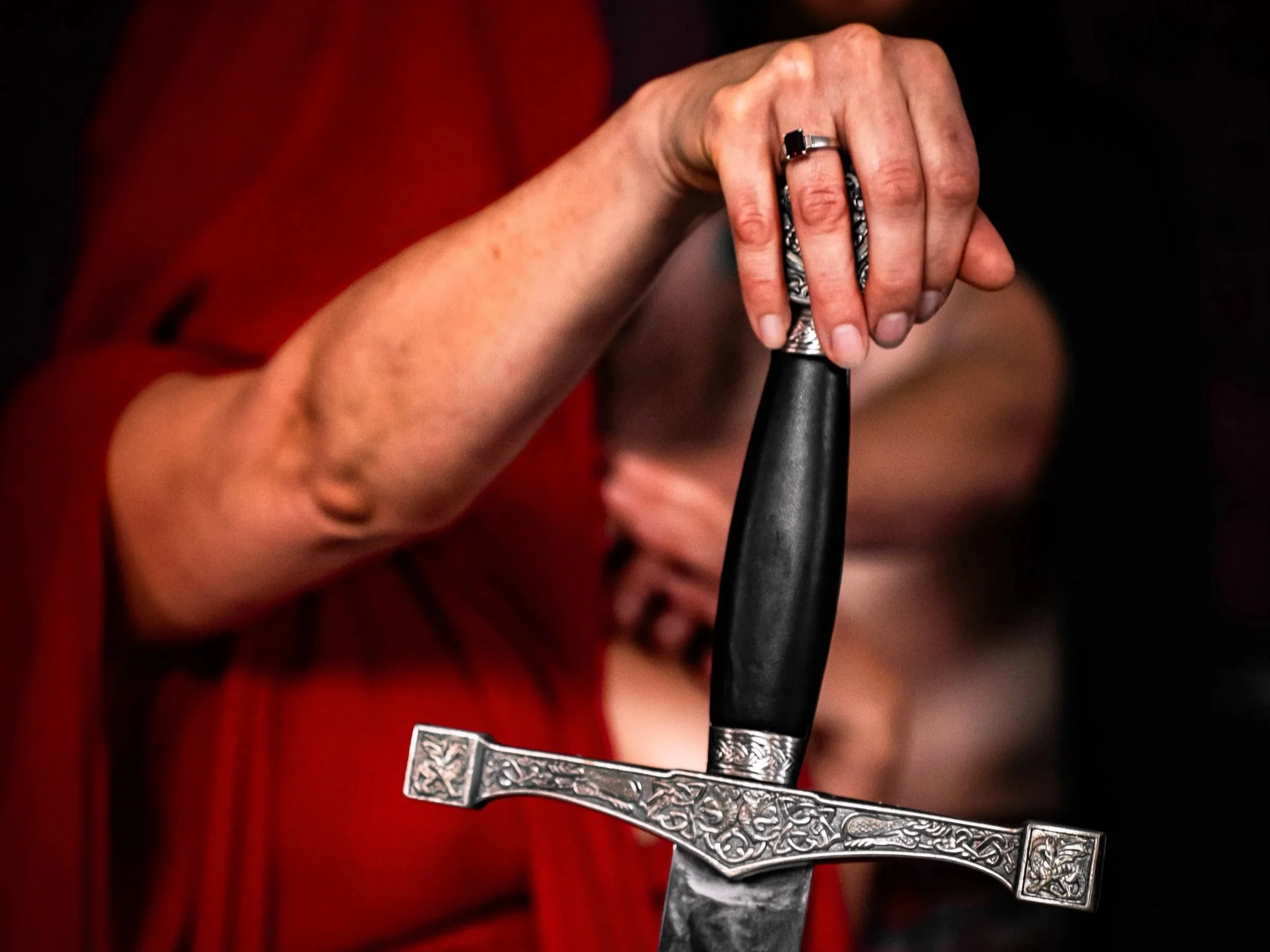
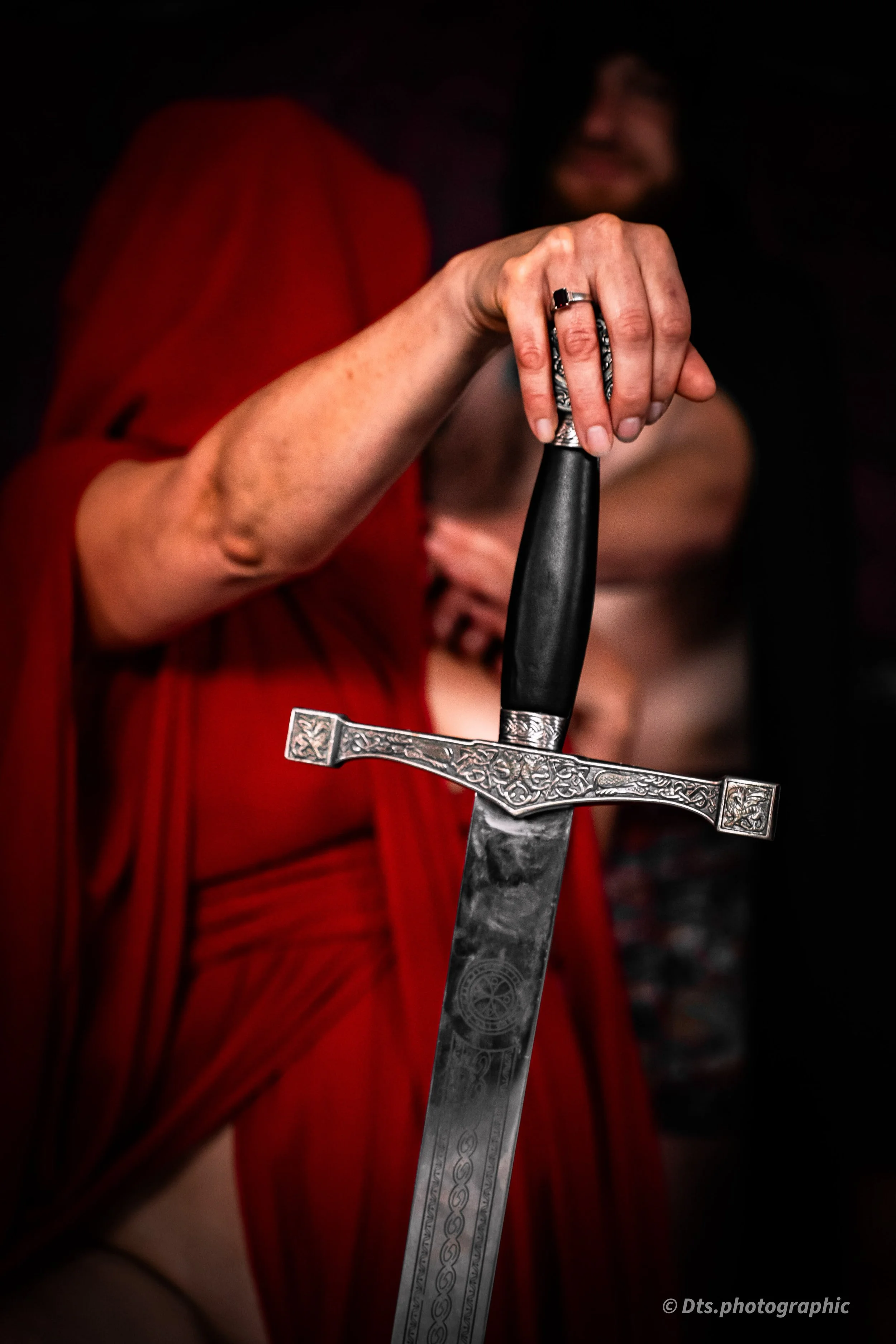
The embodied divine masculine, heart and sex aligned in service to the divine feminine, is the sword of truth. Clear direction, eyes forward, not distracted by allure on either side. Protection, alignment, clarity, focus.
Orpheus shows what happens without it. He goes into the underworld to bring his wife Eurydice back and is told not to look behind him until they're both in daylight. He almost makes it, doubts, turns to check she's there, and loses her forever. The embodied masculine doesn't look back. He trusts because he's devoted.
The sword isn't hardness. It's undivided. He isn't protecting the feminine from feeling; he's protecting her from being scattered. Like a river's banks, he's the structure that lets her run fast, deep and wild and still get somewhere. A river without banks is a flood.
Emotional intelligence
This masculine isn't fearless. He feels fear, desire, anger and grief fully, but none of them steer him, because his heart is the ground underneath. That's emotional intelligence: feeling everything without being run by it.
He holds the ego rather than being held by it. The ego doesn't vanish; it gets a job. And because he's comfortable in his own emotional depths, hers don't frighten him. He doesn't need to fix her, shut her down or run when she gets big. He stays.
Hermes, guide of the descent
Hermes, the Roman Mercury, is the one god who moves freely between the upper world and the underworld. He guides souls down to the ferryman, and in the Persephone myth he's the one sent to bring her back up to her mother.
He doesn't conquer the dark. He knows the way through it and honours the queen who rules there. That's the masculine these stories are calling in: not Hades who takes the feminine down, but the one who walks with her and brings back what's ready to rise.
He's also a trickster. He knows every ego game from the inside, charm, cunning and persuasion, and that's exactly why they don't fool him. In ancient Greece, stone markers of Hermes stood at boundaries and crossroads. He is the clear line, the clean yes and no.
And he was born in a cave, to Maia, whose name means mother. The guide of the underworld came out of the dark womb himself. He can walk the descent without fear because he's going home.
Not separate
Many men carry the same misunderstanding as the woman under a love curse, from the other side. She believes love lives outside her and must be won from a man. He believes the feminine lives outside him and must be won, possessed or controlled through a woman.
When a man truly opens his heart, he finds he was never separate. The feminine isn't something he has to reach. She's the ground he stands on, the heart he beats from, the Earth under his feet. He doesn't stop loving women. He stops needing a woman to make him whole, which is what finally lets him meet one.
The sky right now
These myths are being lived out overhead this autumn.
Venus retrograde in Scorpio: Venus turned retrograde on 3 October 2026 at 8° Scorpio and stations direct on 13 November in Libra. Like Inanna, she drops out of sight and goes below.
The Venus cazimi: around 5am UK time on 24 October, Venus meets the Sun at 0°45′ Scorpio. This is the bottom of her descent, the moment of rebirth in the dark.
Pluto direct in Aquarius: Pluto stationed direct on 15 October at 3° Aquarius. His Greek name, Plouton, means wealth: the riches held below. Scorpio is his sign, so Venus is walking through his realm.
The Mercury cazimi: on 4 November at 2:37pm UK time, retrograde Mercury meets the Sun at 12° Scorpio. Hermes follows Venus to the same place, held in the Sun's heart.
The Scorpio new moon: on 9 November, a place to plant what has come up from the depths.
Venus rules value, so this whole passage asks about worth: what we're really worth, what we've been spending it on, and what we carry back up. The coin is about as literal a symbol for that as there is.
The Mercury cazimi is the messenger receiving a new word in the dark: mind held inside heart. For the masculine, it's where the performed word, the charming word, the breadcrumb word, burns off, and a word spoken from the heart can come through. Embodied masculinity at its simplest is when what he says, what he feels and what he does are the same thing.
Returning to ourselves
Psyche, Sophia and Inanna all believed what they needed was out there: the hidden lover, the Father's light, the throne. Helena believed it was in Demetrius, Echo in Narcissus. Each story is a way of bleeding our power outside ourselves.
And each heroine has to go down, be stripped, and stop grasping. She sorts the seeds, keeps her coin, sits with her sister's pain, grieves until she is met. Only then does she come back into union, because only then has she met herself.
The desire for beautiful pleasure and to be loved unconditionally was never wrong. The person who reawakens it is the match, not the fire. The capacity lives in our own bodies. A woman who's awake in herself doesn't need to be switched on by a man. She chooses who gets to meet her there.
This is sacred union within self first. The inner feminine feels, moves and desires. The inner masculine holds the line, keeps his word, and walks her through the dark without looking back. Together they are the Sophia Christos flame: Wisdom restored to her pair.
From that union, pleasure is born as fruit rather than bait. And whatever love comes next can meet us there, instead of being begged for.
RELATED ARTICLES & RESOURCES
The Embodied Masculine in Alignment with Divine Creation - Channelled Transmission on New Moon in Virgo
Embodying Self, Inner Safety & Peace - A Somatic Guided Meditation including this decree of Reclamation of Self
Sophia Speaks - Guided Meditation to remember your Divinity within
Soul Retrieval through the Heart of Source - Guided Mediation and somatic embodiment
Embodiment of Your Higher Self - Guided Meditation
Navigating Hopelessness and Helplessness - our mental and nervous systems
Patience and Discernment- BRINGING FLOW AND EXPANSION OF JOY IN LIFE! - establishing healthy boundaries, getting off the cortisol wheel of exhaustion
The Ultimate Power of the Feminine - channelled article

COURSES
Daughters of the Golden Rose Lineage Container - for the women that were never meant to fit in!
For the Woman who is Ready to Step into Her Power - The Wise Woman in Her Womb Wisdom
As a Woman Steps into Her Wise Woman Stage, she suddenly sees all the shite she has put up with... aka Menopause!!!
It’s not Mood Swings - It Remembering Your Worth - Your Voice
That Brain Fog - well that's you mind trying to ditch the BS (belief systems)
The aching body - well that's your body saying stop doing all this crap for everyone -
Stop martyring yourself, being the peace keeper at the detriment of your own inner peace and find your boundaries girlfriend!

LOVE2Heal - online course is designed to enable you to hold a deeper awareness of self and the ability to create from a greater level of consciousness, that grows a life of LOVE-JOY-PEACE, a deeper connection to self with love, compassion and trust.
“A must have for self-empowerment and creating a life you desire”